[Disclaimer: this post is not “finished” in any sense. I wanted to publish it, because I think that it deals with some of the underlying threads we should consider as the battle between the legitimacy of the humanities and the bottom lines of the administration continues to wage throughout the country. But I really, really, really have to get back to studying for my quals, so I’ve got to stop editing. PLEASE, if you think something is unsaid or said badly, I invite your comments. Also, I realize that it’s a little narration heavy – you can skip that and go to the end if you want. No big deal.]
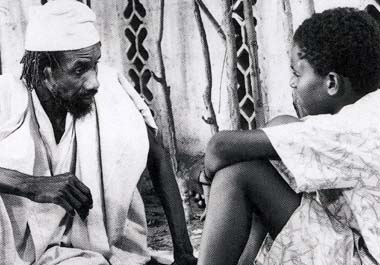
Last week, I did about fifteen minutes of the film Keita * with my students. This was prompted by a short introduction to a West African folktale in their textbook, which claimed that the griot in West Africa is a bard specializing in moral tales about animals for children. While I applaud the inclusion of such culture lessons from the francophone world, and while this description of the griot is not totally wrong, I could not let them leave my classroom thinking that the griot is some kind of Aesop Uncle Remus who lives on African Sesame Street and plays a large ukelele. **
Kouyaté’s film focuses on the education of Mabo Keita, raised in the French colonial school system, whose family’s griot is charged with the task of instructing the young boy in the history of Mandé people(s). Which is pretty significant for this particular family, since its ancestral line links directly back to the founding the Malian Empire.*** The action revolves around this epic tale, but the more subtle circumstances are the tug between Mabo’s French education and the instruction of Djeliba, the griot.
When I watched this film as an undergrad, I remember forming a distinct impression that French literature was inherently bad, and that African oral literature **** was inherently awesome. Which pretty much continued to guide the next…what’s today?…the 18th?…the next nine years of my own education. I had an intellectual swagger. Old white European guys? Psh, who needs ’em? Why don’t you run along back to your Proust.***** I stopped swaggering a long time ago, but I never quite gained the passion for French literature that was supposed to be pounded into me.****** Nos ancêtres les Gaulois ??? Screw ’em – they weren’t mine. But then…neither was Ousmane Sembene…
I have very carefully avoided the French literary canon, until, due to graduate requirements, I was finally forced to tackle it this summer. I am endlessly grateful for this experience, for many reasons that have neither time nor place here. But if I learned nothing else, I learned that a canonical reading list is not a structure to destroy, but a foundation one must carefully construct.****** Because we should care about our knowledge. We should care about Sembene, and we should care about Proust, and we should care about having qualified faculty to teach them both. I believe that back in the old days, before we all became structurally post-colonial medievalists, these were called specialists.
The central problem of Keita is one of disappearing history, customs and relations. Knowledge that is vital not to the survival of “traditional culture” – as if culture could be placed in a jar and put in a cupboard and “kept alive” in any sense of the word – but to the basic understanding of a community as it experiences massive historical change in a short period of time. The problem is how to survive when inherited knowledge – which is not a given, but always being reshaped and reformed – slips through the cracks.
It is somewhat ironic that this film, which led me swiftly away from a canon, has now reappeared unexpectedly to remind me of why we have a canon, why we have specialists, why a griot ‘s knowledge is the intertext of centuries. I am genuinely concerned about the future of a world without seizièmistes. What will happen when there are not people in the world who have spent years of their life in conversation with Michel de Montaigne, the ultimate guidebook for living, dying, eating, shitting, loving, knowing, and practicing the self? I could name a number of centuries or specializations, but I mention the sixteenth century merely because rumor has it from on high that this one isn’t important anymore, unless one’s expertise also extends to digital media and environmental studies, and tap-dancing while singing Gershwin’s collected hits to the undergraduate French business classroom.
The word “interdisciplinary” is being thrown around among the humanities like the word “random” was thrown around about a decade ago. Remember random? Things that didn’t quite fit into a sensical world? Things whose immediate connection to your surroundings you could not see? It was technically an adjective, but it usually functioned as an adverb. One could say the same thing about the word “interdisciplinary.” If you want it to be an adjective, you can hook it up to nouns, like, oh I don’t know, “Neuroscience” or “China Studies” for example. But it is an adverb. It describes a process and an approach. It isn’t a glimpse, it is a seeing.
Interdisciplinarity is invigorating in its openness. The act of putting different disciplines, media, spaces, chronologies, and methods into conversation, effectively breaking down established taxonomies and long-held intellectual prejudices is a thing to support. “Letting go” respected faculty whose expertise does not fit into a narrow, nominal version of “interdisciplinarity” is reprehensible.
* Dani Kouyaté, 1995
** For anyone else who thinks this, I would be happy to recommend sources.
*** And if I say “Sunjata Keita” and mentioned significant 13th century trade routes across North and Subsaharan Africa maybe this will ring a bell.
**** Not “storytelling” or “folktales” because I am not an anthropologist and I had some pretty strong opinions about those as well.
***** I said “Psh” a lot in college apparently. For some reason I also had a lot of disdain for Proust, whose work I had never read. It just sounded nastily canonical to me. Like something that jaded colonialists would read on a train through Bamako. Never mind that my chronological reference points were pretty screwy.
****** Wasn’t French literature, by definition, something that was supposed to be forced upon you?
******* Yes, yes I know what those words sound like.


 Bronwyn Averett
Leave a reply to sztm Cancel reply